Identifying a good VA (Virtual Assistant) is far harder than it sounds. The experience listed on a resume and a single interview rarely predict the actual capability that surfaces once you are working together. Whether someone reads English email quickly and accurately, handles schedules and numbers without slipping, and makes sound judgments on their own when instructions are vague: none of this is written anywhere in a cover letter.
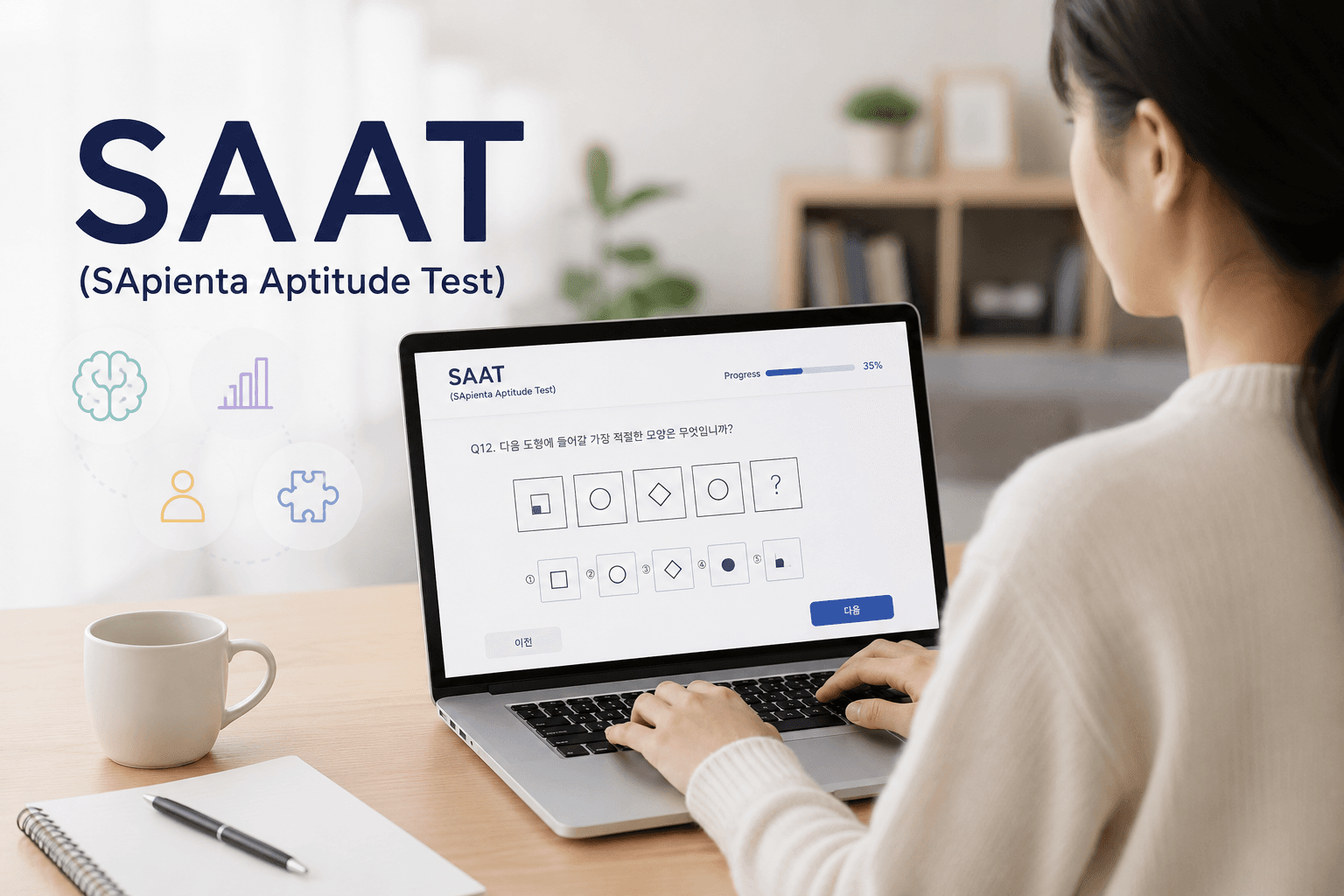
So we decided to build our own aptitude test. We call it SAAT (Sapienta Aptitude Test). Before building it, we first studied the tests that already exist in the world.
Existing aptitude tests, and why we could not simply use them
Hiring aptitude tests have a long history. The American Wonderlic Test is a cognitive ability test of 50 questions in 12 minutes; it measures speed of learning and problem solving and has long been used in corporate hiring (it is also famous for being used to evaluate NFL rookies). The CCAT (Criteria Cognitive Aptitude Test), favored by startups and IT companies, uses 50 questions in 15 minutes to assess critical thinking and logic. The SHL tests, used almost as a standard by global firms, measure numerical reasoning, verbal reasoning, and inductive reasoning, finely tuned by job function.
Korea is no different. Large-company aptitude tests such as Samsung's GSAT and SK's SKCT combine numerical, reasoning, and verbal ability with a personality assessment to screen hundreds of thousands of applicants objectively.
Looking closely at these tests, we realized two things. First, that well-built tests share a common focus: cognitive ability (fast, accurate thinking) and consistent attitude (reliability). Second, that most of them were designed for office roles at large companies and for entry-level open recruitment.
What we needed was a little different. Our VAs support Korean clients remotely, without face-to-face contact, in English. English reading comprehension is essential, a feel for Korean business culture is needed, and they must work reliably and asynchronously even when no one is watching. Not one of the existing tests captured this combination as it was. So we chose to borrow the proven principles but design something new, fit to our roles. That is also why we built it to be taken in three languages: English, Korean, and Tagalog.
What SAAT measures, and how: six areas
SAAT consists of 55 questions, 40 minutes, and six areas. Each area has a clear purpose.
A1. English Reading Comprehension (8 questions): The core of VA work is, in the end, English communication. This area checks whether the candidate reads email and work documents and grasps the key points accurately. It is the ability to read at length and understand quickly.
A2. Numeracy (6 questions): Schedule calculations, billing and exchange rates, simple data handling. A small slip with numbers quickly becomes a work incident. This area assesses basic arithmetic, ratios, and the ability to interpret tables.
A3. Logical Thinking (6 questions): Whether the candidate applies given rules and conditions to reach the correct conclusion. This is the ability to structure ambiguous instructions on one's own, and it is the area we confirmed in our data to have the highest discriminating power.
B. Situational Judgment (SJT, 10 questions): This presents dilemmas encountered in real work and asks the candidate to choose the "most appropriate response." It looks at prioritization, professional communication, and cultural sensitivity.
C. Job Simulation (5 questions): In real-world scenarios such as an urgent client request late at night, a third party demanding confidential information, or a scheduling conflict, the candidate chooses the best judgment. Rather than right or wrong, responses are scored on a sliding scale from 5 points down to 1 point based on appropriateness.
D. Conscientiousness and Consistency (20 questions): Whether the candidate maintains an attitude consistent with earlier answers, and whether they overstate themselves (social desirability). This area is used not as a score but only as a reliability flag (the reason is explained below).
For every sitting, a different set is drawn at random from a pool of more than 500 questions, person by person. Even if someone takes the same test twice, the questions do not overlap, which reduces the impact of leaked content and repeated attempts.
What we learned while building it: measurement must be honest
"Building a test" and "building a test that screens well" turned out to be entirely different things.
The longest option was the correct answer. When we first finished the multiple-choice questions, we discovered that the most appropriate answer was always the longest among the options. Knowing nothing about the content, simply picking "the longest option" was correct 97 percent of the time. That is the moment a test loses its meaning. We rewrote every option so that length would not hint at the answer, balancing them out. Fair assessment is decided in details like this.
An area everyone does well on cannot separate people. When we analyzed the results statistically, some areas saw nearly everyone score 90. That means no discrimination. By contrast, numeracy and logic spread widely, from 33 points up to 100. So we lowered the weight of "easy areas where everyone does well" and raised the weight of "areas where real differences in ability show." We set the weighting by data (the variance of scores per section), not by gut feeling.
Honesty should not inflate the ability score. On the conscientiousness area, an honest person mostly scores high. If you add that directly to the ability score, total scores rise just from being honest. So we excluded this area from the score total and used it only as a reliability flag. We do not mix ability with attitude. That is a basic principle of measurement.
The most important question: does this test really predict performance?
A test is ultimately validated by a single question: "Do people who score higher actually do better work?"
So we had the Filipino VAs already working with us take SAAT directly. Then we placed their actual job capability, the accuracy of their output, and their work attitude, as we had come to understand them over months of working together, side by side with their test grades and compared.
The results were encouraging. By and large, the VAs with higher grades were also the strongest in actual work. The team members we already trusted landed in the upper grades, and the cases that needed support fell naturally into the lower grades. In that what we had felt from observing people and what the data showed pointed to the same place, we gained confidence that this tool was aimed in the right direction.
That said, we say it honestly: this test is not an absolute indicator. There are clearly VAs whose grades came out somewhat low yet who do excellent work in the field. A single test cannot capture everything about a person. Values that do not translate into a score, such as diligence, a sense of responsibility, and trust with clients, still have to be seen by a person directly.
So we use SAAT not as a "final pass/fail tool" but as a "first-round screening tool." We use it as the first gate to objectively confirm the foundation, things like basic English reading comprehension, numeracy, and consistency of answers, and to those who pass, we separately give a task closer to real work to confirm once more whether the score reflects true ability.
Hiring is a precise craft
Measure, analyze, remove bias, then measure again. We approach hiring as if engineering it. There is no perfect test, but we believe a fairer and more accurate one can be built.
Bringing good talent and a good company together takes that much care. With data and with care, we will find the best VA to work alongside you.